
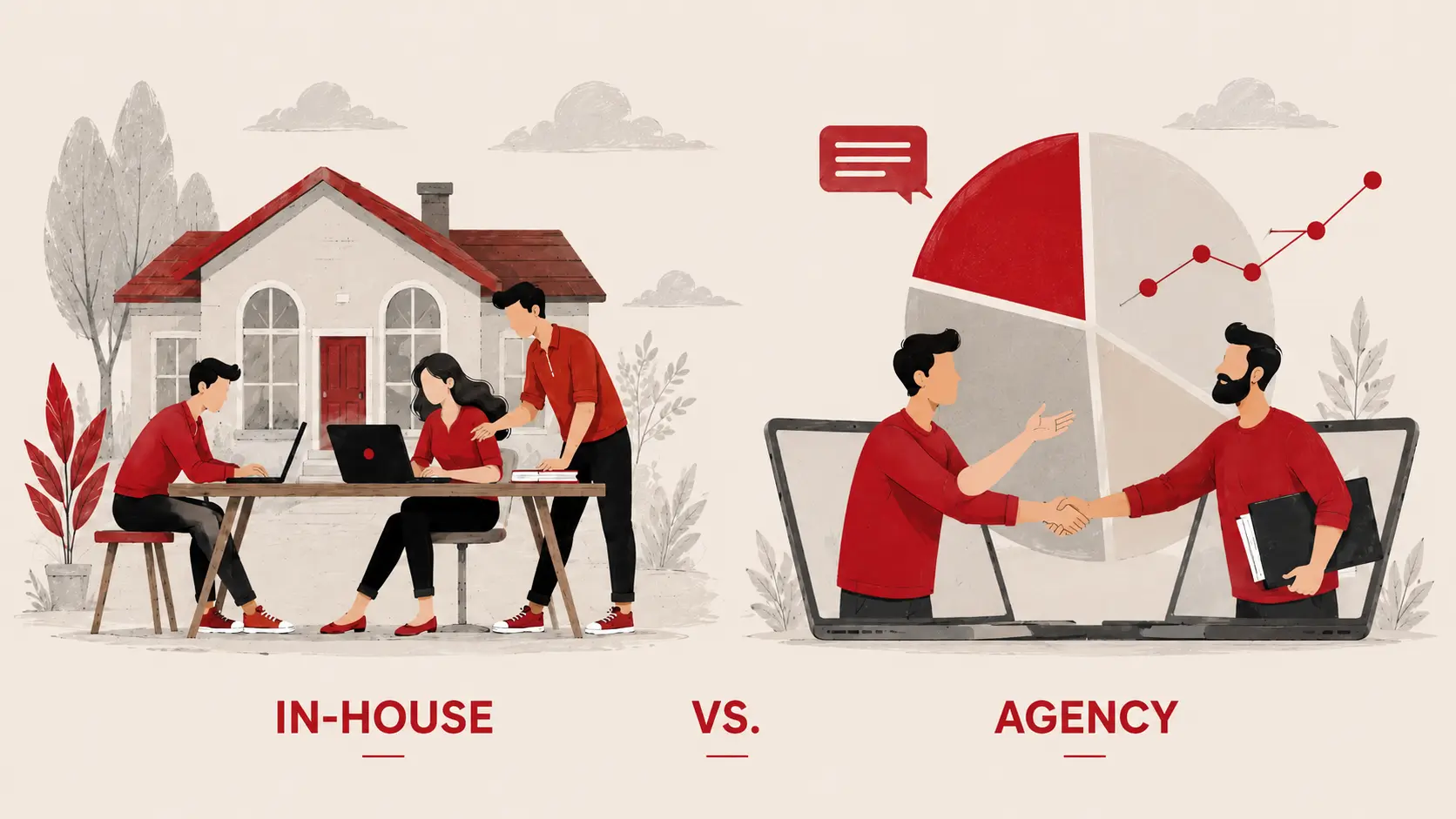



You are not deciding between marketing and no marketing, but rather between how to build something that drives revenue consistently while everything around you keeps changing. AI is reshaping how teams operate, the channels that worked last year may not work today, and buyers now expect to see real results before they agree to get on a call with your sales team.
Getting the resourcing wrong here costs more than the budget. You lose time, momentum, and most importantly – you get behind competitors who understand the need for the right marketing.
In 2026, most marketing leaders are being asked to grow on flat budgets while the role has expanded well beyond creative — into analytics, automation, and AI-enabled production. As a result, teams are experimenting by keeping core capability in-house for speed and control, while leaning on agencies for specialized skills, faster output, or an outside perspective.
1. Mature in-house teams: larger companies with a marketing or creative director leading strategy and an internal team executing.
2. Small in-house teams: one or two execution-focused hires while senior leadership sets direction without a dedicated marketing leadership. The drawbacks of which are misalignment and wasted effort.
3. Agency-led: an agency owns strategy and execution end-to-end, acting as the primary marketing function. This can move fast and add depth but only works when internal leadership stays responsive and close to decisions.
4. Hybrid: an internal owner sets priorities; an agency handles specialist execution. The most flexible structure, but only when roles are clear.
While teams usually look at the initial cost (salary cost) when making decision, it usually lays far from the total cost spent at the end – with hidden costs that come from onboarding, recruitment, ramp time, management overhead, software, and the opportunity cost of slow execution.
For small and medium companies growth means first upgrading their existing systems and adding new ones to the list – from website revamp to updated marketing collateral, and multi-channel marketing campaign. The skills required span marketing strategy, SEO, UX/UI, development, copywriting, social, and paid media.
Comparison what it tends to cost to achieve results:
In-house: Minimum one senior owner plus two supporting hires, with the rest outsourced. Two months recruiting, one month onboarding, one month on strategy. That's three to four months before real work starts, six to seven before results. Cost: $150k–$200k/year internally, plus $50k+ outsourcing.
Agency: When you choose an agency, you are ultimately choosing speed and coordination over building capacity from scratch, on top of that - specialized agencies come with deep industry knowledge and a broad set of skills that can take years to build. Alignment takes one to two weeks. Website, collateral, and campaigns run in parallel over the following four to eight weeks. Early traction typically shows up around week eight to twelve — assuming decisions and feedback move quickly.
One important caveat, any time you’re thinking about hiring in-house: if the plan is to hire one or two marketers without senior marketing leadership, you are often buying execution without clear direction.
If you are choosing “in-house,” it usually works best when you have the time and budget to build an internal marketing team from the top, then support it with at least two early hires for consistent output. This means for a company to use their resources effectively for both short- and long-term strategic goals, you’ll actually need to budget 2-3 roles.
Most companies we speak to try to solve this by hiring a senior marketing leader, then pushing execution onto someone who already has another full-time job inside the business. On paper, it looks efficient, but it rarely is. The ‘lucky’ person often gets the role simply because they post frequently on social media or have used Canva enough to make something look decent. That choice usually signals, even if unintentionally, that marketing is easy and interchangeable, which undercuts the function before it has a chance to perform.
The structure also splits focus in a way that creates predictable failure. The new leader is forced to live in strategy and prioritization without enough hands to produce high-quality work, while the supporter defaults to what they can produce quickly, like posts, basic updates, and surface-level engagement. The result is a lot of activity, but weak impact on the pipeline and revenue, and both roles end up underperforming.
So, when should you ultimately be hiring in-house?
When an agency is usually the better move
The hybrid model: what high-performing teams tend to do
The highest-performing setups are often hybrid. An internal owner sets priorities, guards the strategy (which is often a collaborative effort between the owner and the agency), and manages internal alignment. An agency or fractional team provides specialist execution and systems capacity, especially for web, SEO/GEO, automation, and content production. This model also reduces the risk that marketing becomes a silo, because operations and sales systems are built alongside messaging and creative.

Use these questions to pressure-test the choice. If you answer yes most in the left column, lean in-house. If yes to most in the right column, lean agency or hybrid.
With all of that in mind, the choice is rarely as simple as agency versus in-house. It comes down to what your business needs right now: ownership, speed, specialist depth, and/or operational cleanup. Most leadership teams are not trying to buy marketing, they are trying to build a system that reliably turns attention into conversations, conversations into pipeline, and pipeline into closed revenue, without creating internal chaos or bloated tooling along the way.
That is where the right partner can make the biggest difference, especially when the constraint is not ambition, but bandwidth, and ensuring all departments effectively communicate with each other, and support each other. If you need to work done quickly, but you also need the sales pipeline, follow-ups, and internal handoffs to actually function, then the marketing solution has to include systems and operational support, not just campaigns.
At Inquill Agency, we start by having a working conversation with decision-makers and department leads to understand how Sales, Marketing, Operations, and Tech currently operate, where handoffs break, and what is slowing growth.
From there, we integrate in the way that best fits the situation. Sometimes that means supporting marketing execution. Sometimes it means rebuilding the systems that connect lead capture, pipeline stages, follow-ups, and reporting. And in cases where growth is being limited by day-to-day friction, it can mean stepping into operations to make the engine more cost-effective and easier to run, the same way we did with Decarb Summits.
The goal is not to deliver marketing in isolation, but to align priorities across teams, remove friction from the buying journey, and make outreach, conversion, and retention easier to run without adding confusion in the tech stack. That combination matters when the real work is not only content and campaigns, but the infrastructure that turns visibility into tracked conversations and repeatable conversions.
So, if you’re evaluating options and need some more advice, get in touch with one of our experts.

.svg)
.svg)

.svg)
.svg)
